
Reviewed · KUSADASI SHORE EXCURSIONS
NEW: Private The Most Detailed Ephesus Shore Excursion / with Lunch
Ephesus is far more than a quick photo at the Library of Celsus. This private tour traces the city’s working parts, from the State Agora and ancient water supply to the council hall, public baths, temples, and grand streets. You also visit Mary’s House, St. John Basilica, and the remains of the Temple of Artemis.
I like the private format, which lets your guide adjust the pace and explain details that larger groups often skip. I also like the included Turkish lunch, plus transport in a Mercedes van with air-conditioning. Guides named Selin, Nesli, Ahmet, Mary, Asli, and Özgür have been especially praised for making the day personal and easy to follow.
The catch is cost clarity. The advertised price is $79.20 per person, but the major entrance fees are extra. Add the listed €40 Ephesus ticket, €18 for Mary’s House, €15 for the Terrace Houses, and €6 for St. John Basilica, and the total can rise quickly. A rug presentation may also be included in the day, and some people found the sales pitch unwelcome.
Key points before you book
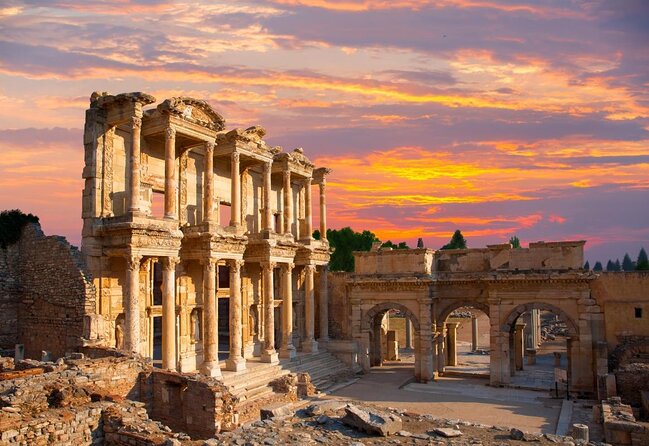
- A private route through Ephesus: Your group has its own guide and vehicle, with room to adjust the day to your interests.
- More than the postcard sights: The tour covers the State Agora, Odeion, Domitian Temple, Hercules Gate, baths, fountains, and civic buildings.
- The Terrace Houses cost extra: They are one of the best additions for anyone interested in Roman home life, mosaics, and wall paintings.
- Lunch is included: Drinks are not, and the meal is served at a local restaurant.
- Plan for extra admission fees: Several major sites are outside the advertised tour price.
- Allow the full seven hours: Cruise passengers should keep a close eye on the return time, especially if the ship has a firm departure.
Why this Ephesus tour feels different
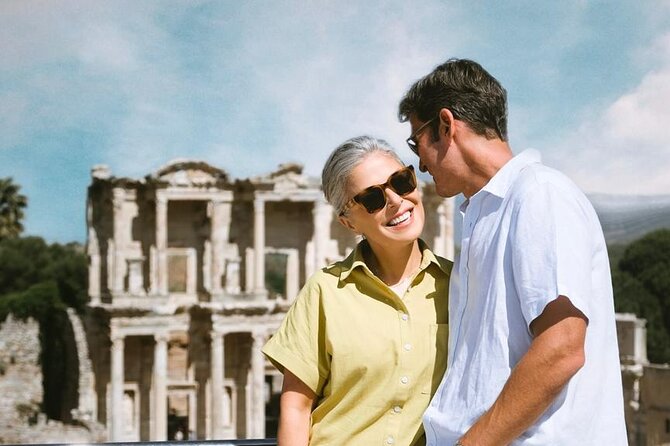
Many Ephesus visits focus on the Library of Celsus and the Great Theatre, then hurry toward the exit. This outing gives those famous monuments their due, but it also explains how the city functioned.
You look at the places where officials met, citizens gathered, water was stored, and wealthy families lived. That wider view matters. Ephesus was not simply a collection of marble ruins. It was a city with politics, trade, religion, entertainment, and ordinary domestic life.
The private setup helps here. Your guide can spend more time on Roman government if you are curious about politics, or focus on early Christianity, architecture, or daily life if that suits your group better. Guides such as Selin, Nesli, Ahmet, Tas, Asli, Devon, Özgür, Ali, and Mary have been singled out for clear explanations and warm, flexible guiding. If the booking system lets you request a guide, those are useful names to ask about, though availability is not guaranteed.
The tour lasts about five to seven hours. That is enough time for a serious visit, but it is not a light sightseeing hop. You will be on your feet at archaeological sites, often over uneven ground and steps, so a moderate level of fitness is expected.
More shore excursions from the port:
- FOR CRUISERS: Skip The Lines PRIVATE EPHESUS TOUR &On Time Return
★ 5.0 · 8,527 reviews - Top Choice For Cruisers: Ephesus, Mary’s House WITH TICKETS+LUNCH
★ 5.0 · 7,233 reviews - PRIVATE EPHESUS TOUR FOR CRUISERS: On-time Return and Skip-Line
★ 5.0 · 5,807 reviews
Mary’s House and the opening view of the day
The first stop is Meryemana, known as the House of the Virgin Mary. You have about 30 minutes here, and the admission fee is not included.
The site has religious importance and is visited as the place where Mary is traditionally believed to have spent her final years. This is a quieter beginning than starting in the center of Ephesus, and it gives you a chance to settle into the day before the larger ruins.
Do not expect a long museum visit. The stop is short, and the main value is the setting, the tradition attached to the house, and your guide’s explanation. If your group has strong religious interests, tell the guide early so the visit can receive the attention it deserves.
Ephesus from the State Agora to the Odeion
The ancient city visit is the heart of the excursion. The route includes Harbour Street, Marble Street, the Commercial Agora, the Latrina, Hadrian’s Temple, the Scholastica Baths, Trajan’s Fountain, Curetes Street, the Polio Fountain, the Memnius Monument, the Temple of Domitian, the Prytaneion, the Odeion, and the State Agora.
That list may sound like a lot, but it is exactly why a private guide helps. Without context, many of these places look like scattered blocks. With explanation, you begin to see the city’s civic plan.
The State Agora was not a market. Built in the first century BC, it was used for official business and government discussions. Excavations found older graves, an archaic terracotta sarcophagus, and a paved road, showing that the area had also served as a burial ground in an earlier period.
A water reservoir at the Agora once helped supply the city. Water came through the Pollio Aqueduct, whose remains can be seen several miles away. This is a small detail, but it changes how you read the ruins. Ephesus depended on engineering as much as on temples and theatres.
The Odeion is a compact, semicircular building with about 1,500 seats. It served two purposes: a concert hall and a meeting place for the Boule, or council. The larger Great Theatre hosted public gatherings, while this smaller building was used by another governing body. Parts of the seating and stage have been restored, making it easier to picture the building in use.
The tour allows about 15 minutes at the State Agora and 15 minutes at the Odeion. That is enough for a focused explanation, but not a long independent exploration. If you want detailed time at every ruin, you may need to agree on priorities with your guide.
Imperial power at Domitian’s Temple
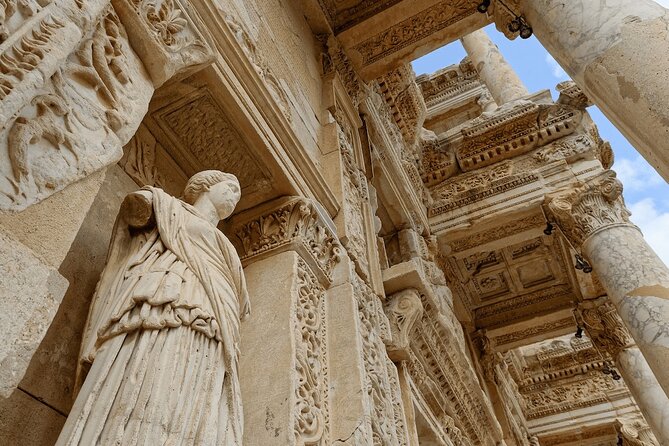
The Temple of Domitian was the first known structure at Ephesus dedicated to an emperor. It occupied a high terrace measuring about 50 by 100 meters, supported by vaulted foundations.
The temple itself is mostly gone, but the site tells an important political story. Ephesus received permission during Domitian’s reign to become a neokoros, a city with the honor of maintaining an imperial cult temple. That status brought prestige and showed the city’s place within the Roman system.
You can still see the large terrace and stairs. Your guide may spend only about 15 minutes here, but the stop is useful for understanding how local pride and Roman authority worked together.
More ways to see Ephesus:
- PRIVATE NO HIDDEN FEES Ephesus, Mary’s House Guided Tour /GRP OPT
★ 5.0 · 2,455 reviews - For Ship Guests:BEST SELLER EPHESUS PRIVATE TOUR & On Time Return
★ 5.0 · 2,029 reviews - ALL INCLUDED: Ephesus Ruins, Mary’s House Tour incl ENTRY TICKETS
★ 5.0 · 1,670 reviews - Ephesus Temple of Artemis and House of Mary Private Half Day Tour
★ 5.0 · 1,573 reviews
Curetes Street, Hercules Gate, and Hadrian’s Temple
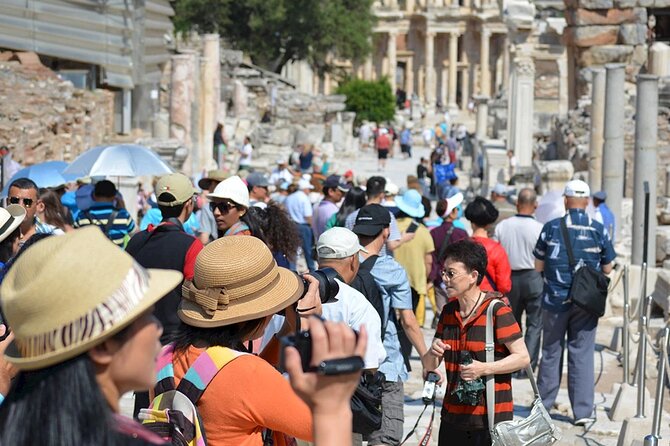
Curetes Street is one of the most memorable parts of Ephesus. It runs past columns, fountains, monuments, and the Terrace Houses, leading toward the Library of Celsus.
At Hercules Gate, only the two side columns remain. The reliefs of Hercules date to the second century AD, while the gate was moved to its current location in the fourth century. Its narrow opening blocked vehicles, suggesting that this section of the street had become pedestrian-only by that time.
That is a nice example of how the ruins reveal changes in city life. Ephesus was not frozen in one perfect Roman moment. Streets were altered, buildings were reused, and the city’s needs changed.
Hadrian’s Temple is one of the most graceful surviving structures on Curetes Street. Four Corinthian columns support a curved arch with a relief of Tyche, the goddess associated with fortune and victory. The temple was built before AD 138 and honored Emperor Hadrian after his visit to Ephesus.
The stop lasts about 10 minutes. It is short, but the building is easy to appreciate, especially when your guide points out the later imperial statue bases in front.
The Terrace Houses are worth the added fee
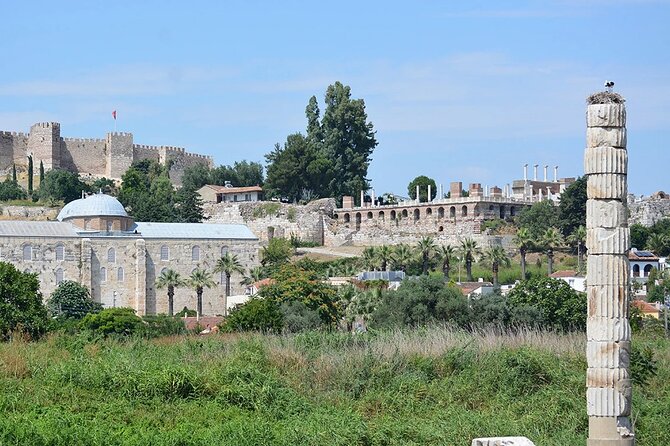
The Terrace Houses sit opposite Hadrian’s Temple and require a separate €15 admission fee. I consider them one of the most useful additions for anyone who wants more than monumental architecture.
These were homes of wealthy Roman families, built on three terraces along the lower slope of Bulbul Mountain. Six residential units have been identified, with use continuing from the first century BC into the seventh century AD.
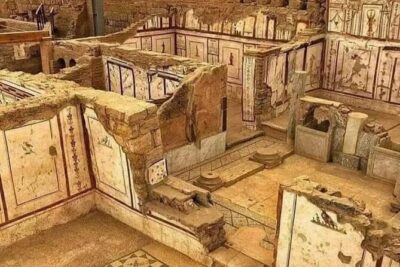
Inside, protective roofing shields the remains. Two houses are open as a museum, with preserved mosaics and wall paintings. You get a better sense of family life here than you do from a temple facade. Rooms, floors, decorative details, and the arrangement of the homes help connect the ancient city to everyday living.
There are stairs, and the stop takes about 30 minutes. One guide specifically helped a visitor see why the stairs were worth the effort. If you have limited mobility or dislike steps, ask about the route before paying the extra fee.
The Library of Celsus and the Great Theatre
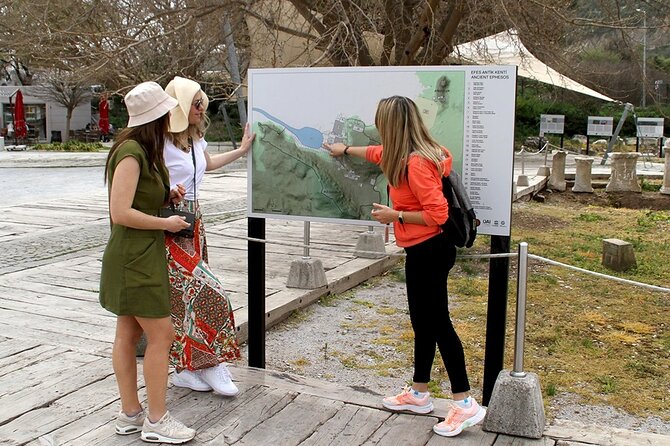
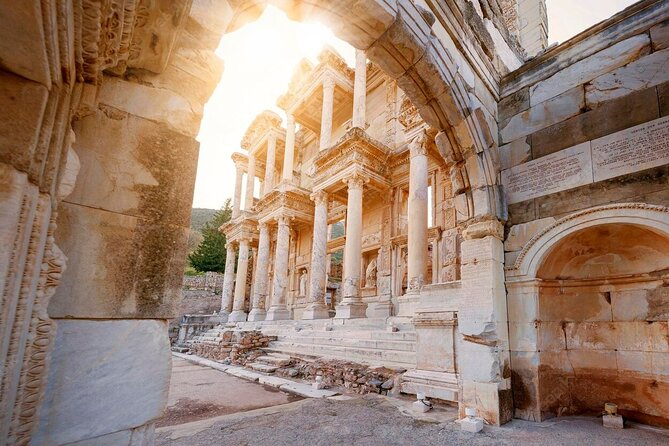
The Library of Celsus is Ephesus’s most recognizable building, and it deserves the attention it gets. Built in AD 117, it served as a monumental tomb for Gaius Julius Celsus Polemaeanus, governor of the province of Asia. His burial chamber was placed beneath the ground floor.
The library held more than 12,000 scrolls. Double walls helped protect the manuscripts from heat, cold, and humidity. Statues associated with wisdom and civic virtue decorated the facade, although the originals are no longer in place.
You have about 30 minutes here. That gives you time to hear the story, take photographs, and look closely at the facade without rushing straight through.
The Great Theatre is larger in scale and louder in impact. Built first in the Hellenistic period and later expanded by the Romans, it held about 25,000 people. Its seating is divided into three sections by two horizontal walkways.
The theatre hosted plays and concerts, but also political meetings, religious events, philosophical discussions, gladiator contests, and animal fights. This was a public center, not simply an entertainment venue. The tour allows about 25 minutes, and the theatre is one of the places where the guide’s explanation adds real value.
The theatre entry is listed as included for that stop, but the general Ephesus admission fee is separately listed at €40 per person. Clarify the ticket arrangement with your guide so there are no surprises.
Artemis, St. John, and the Christian chapter
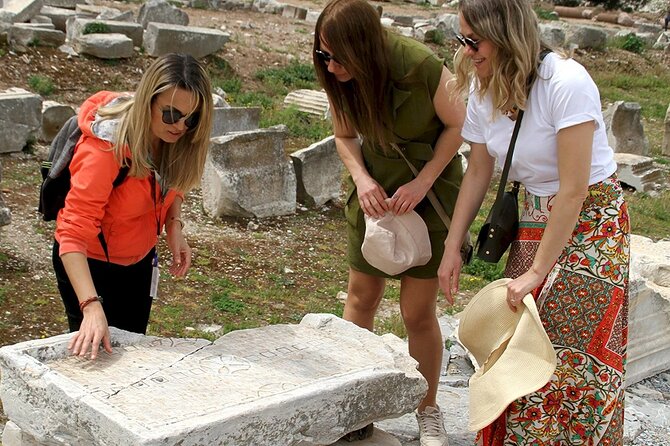
The Temple of Artemis takes about 40 minutes. It was one of the Seven Wonders of the ancient world, though almost all that remains today is the foundation and a few fragments.
The temple once stood on ground that later became marshy. Its best-preserved sculptural pieces are now in the British Museum in London. At the site, you need to use your imagination, but the stop gives useful scale to the fame of ancient Ephesus.
The final major stop is the Basilica of St. John, with about 40 minutes allotted. St. John is traditionally believed to have spent his later years near Ephesus and to have been buried on Ayosolug Hill. A small chapel was built over the grave in the fourth century, and Emperor Justinian later replaced it with a large basilica.
This stop shifts the story from Roman civic life to early Christianity. The basilica’s setting and remains help connect local tradition with the wider story of the early church. Admission is listed at €6 per person.
Turkish lunch, transport, and the shopping question
Lunch is included at a local restaurant, but drinks are extra. The meal has been described as plentiful, and one particularly memorable detail was olive oil and pomegranate juice used in a salad dressing. Fresh pomegranate juice and local figs may also appear during the day, though they should not be treated as guaranteed inclusions.
Transport is by air-conditioned Mercedes van. Pickup and drop-off are offered from the cruise port, hotels, and the domestic airport. Cruise passengers meet the driver at the exit gate of the immigration terminal, where an OTTI Travel sign is displayed.
Some versions of the day include a carpet-making presentation after lunch. Seeing how the rugs are made can be interesting, but the sales portion is not for everyone. You may encounter repeated offers to buy, even if the staff remain polite. Tell your guide if you want to keep shopping brief.
For a cruise visit, leave a generous time cushion. One group returned late enough that the ship delayed departure by 30 minutes. That worked out, but you should not count on the same luck. Give the guide your ship name, docking time, disembarkation time, and re-boarding time when you book.
Is the $79.20 price a good value?
The $79.20 per-person price is appealing for a private tour with a guide, vehicle, parking, lunch, and pickup. For a couple or family, the private format can be much better value than paying for several separate taxis or trying to coordinate the sites yourself.
The important point is that the entrance fees are not included. The listed extras total €79 per person if you visit all four chargeable sites: Ephesus at €40, Mary’s House at €18, the Terrace Houses at €15, and St. John Basilica at €6. Exchange rates will affect the final amount, and lunch drinks are also extra.
Ask for a clear ticket total before the tour begins. The guide may be able to buy tickets ahead of time, which helps you avoid long lines, but that does not make the fees disappear.
Who should book this private Ephesus tour?
I would choose this tour if you want a serious, flexible look at Ephesus and prefer having one guide explain the connections between the sites. It suits families, couples, and small groups with mixed interests, especially because the guide can adjust the pace.
It is also a good fit for cruise passengers who want port pickup and a private vehicle. Just protect your return time and do not let lunch or shopping stretch the day.
I would look elsewhere if you want a bare-bones visit with no extra costs, dislike archaeological walking, or have no interest in the Terrace Houses, St. John Basilica, or Mary’s House. The itinerary is ambitious, and the entrance fees can bring the real cost well above the headline price.
Should you book it?
Book this excursion if you value personal guiding, a broad route, and the chance to ask questions as you go. The strongest part is the human element: guides such as Selin, Nesli, Ahmet, Mary, and Özgür have made the day feel tailored rather than scripted.
Before booking, budget for the €79 in listed admissions, confirm the lunch and shopping arrangements, and set a firm return time if you are sailing. With those points settled, this is a strong choice for seeing both the famous face of Ephesus and the less obvious details that make the ancient city understandable.
FAQ
How long does the Ephesus shore excursion last?
The tour lasts approximately five to seven hours.
What is included in the tour price?
The price includes an English-speaking professional licensed guide, pickup and drop-off, a Mercedes air-conditioned vehicle, parking fees, lunch, and assistance with skipping long lines.
Are Ephesus admission fees included?
No. The listed admission fee for the Ancient City of Ephesus is €40 per person.
Is admission to Mary’s House included?
No. Admission to the House of the Virgin Mary is listed at €18 per person.
Is the Terrace Houses ticket included?
No. The Terrace Houses require a separate listed admission fee of €15 per person.
Is St. John Basilica included?
No. Admission to St. John Basilica is listed at €6 per person.
Are drinks included with lunch?
No. Drinks at lunch are not included.
Where do cruise passengers meet the tour?
Cruise passengers meet at the exit gate of the immigration terminal at the cruise port. The guide holds a board marked OTTI Travel.
Is this a private tour?
Yes. Only your group participates in the private tour or activity.
What information must cruise passengers provide when booking?
You must provide your ship name, docking time, disembarkation time, and re-boarding time.
Can I cancel the tour?
You can cancel for a full refund if you cancel at least 24 hours before the experience start time. Changes or cancellations made less than 24 hours before the start time are not accepted and are not refunded.
More Lunch Experiences in Kusadasi
- SKIP-THE-LINE: Group & Private Ephesus Tour ENTRY FEE & LUNCH
★ 5.0 · 935 reviews - ALL INCLUSIVE Private Ephesus, House of Virgin Mary with lunch
★ 5.0 · 819 reviews - Ephesus: Mary’s House Private & Group Tour with Ticket+Lunch
★ 4.8 · 738 reviews - ALL INCLUSIVE Private Ephesus, House of Mary, LUNCH, Entrances
★ 5.0 · 735 reviews
Just added around Kusadasi
- Quick-Ephesus Private Tour★ 5.0 · 10 reviews
- ONLY FOR CRUISE GUESTS / Top Seller Ephesus Tour★ 5.0 · 9 reviews
- Private Pamukkale and Ephesus Tours★ 4.5 · 3 reviews
- For Cruisers : Private Ephesus Tour With Local Tour Guide★ 5.0 · 8 reviews
- Private Tour : Ephesus Port Tour for Cruisers★ 5.0 · 4 reviews
- Private Tour of Ephesus,House of Mother Mary &Artemis Temple from Izmir★ 5.0 · 4 reviews
- For Cruise Guests : Best of Ephesus Private Tour / Kusadasi Tours★ 5.0 · 6 reviews
- FOR CRUISE GUESTS : Ephesus Private Tour / ON TIME RETURN TO SHIP★ 5.0 · 13 reviews
Kusadasi Shore Excursions, compared.
FOR CRUISERS: Skip The Lines PRIVATE EPHESUS TOUR &On Time Return
Read our review →
Top Choice For Cruisers: Ephesus, Mary’s House WITH TICKETS+LUNCH
Read our review →
PRIVATE EPHESUS TOUR FOR CRUISERS: On-time Return and Skip-Line
Read our review →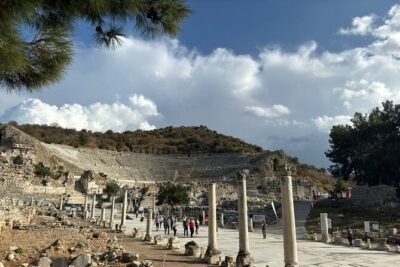
PRIVATE TOUR FOR CRUISERS: Mary’s House (Meryemana) and Ephesus
Read our review →
Top-Rated: Ephesus & Artemis Tour for Cruisers WITH ENTRY TICKETS
Read our review →
Ephesus Cruiser Private or Small Group Tour, TICKET and LUNCH Opt
Read our review →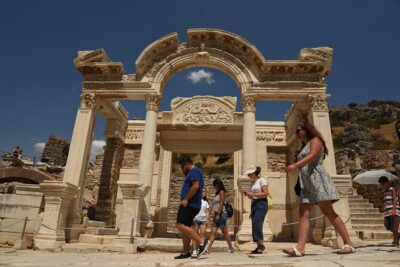
Top-Rated Ephesus and House of Virgin Mary Tour for Cruisers
Read our review →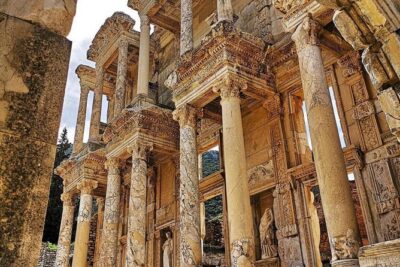
3-Hour Private Ephesus, Terrace Houses, Cruiser Only
Read our review →Browse the lists this tour appears in