Reviewed · EPHESUS TOURS FROM KUSADASI
Ephesus Small Group Day Tour from Kusadasi
Ephesus is the star here, and rightly so. Its marble streets, vast theatre, public baths, latrines, and grand Celsus Library give you a clear picture of Roman city life instead of a quick glance at scattered ruins. I especially like the small group limit of 15 and the fact that entrance fees, lunch, transport, and hotel pickup are included.
I also like the range of the day. You get ancient Greek and Roman sites, a Christian pilgrimage stop, Seljuk architecture, and a Turkish meal in one outing. The main caution is that some departures have included carpet, leather, jewelry, or pottery stops that can feel like sales visits, so ask about the day’s route before you set out.
Key points to know before booking
- Ephesus gets the time it deserves: Plan on about two hours among the main ruins, with extra time at the Great Theatre and Celsus Library.
- The group is capped at 15 people: That is small enough for easier questions and closer contact with your guide.
- The House of Virgin Mary is a religious stop: You can see the shrine and drink from a spring associated with healing beliefs.
- Lunch and entrance fees are included: Drinks cost extra, so carry some Turkish lira or another accepted payment method.
- The tour covers several eras: Roman Ephesus, an early Christian shrine, a Seljuk mosque, and the remains of Artemis Temple.
- Pickup times are flexible: Kusadasi pickups generally occur between 8:00 and 9:00 a.m., with the final time confirmed the day before.
Ephesus gives this tour its real purpose
At about $174.60 per person, this is not the cheapest way to see Ephesus. It is priced as a full-service outing, though, with hotel or port pickup, an air-conditioned vehicle, an English-speaking local guide, lunch, entrance fees, and return transport.
That matters in Kusadasi. Ephesus is close enough for a short drive, but the site is large and far more rewarding when someone points out what you are seeing. Without guidance, it is easy to admire the famous facade of the Celsus Library and miss the details around it, such as the public spaces, streets, fountains, and political buildings that made the city work.
The tour lasts about seven hours, although the exact day can vary with pickup times and the number of stops. It begins in the morning and ends back at your Kusadasi hotel. If you are arriving by cruise ship, port pickup is also included, which can save you the trouble of arranging a separate taxi.
More ways to see Ephesus:
- FOR CRUISERS: Skip The Lines PRIVATE EPHESUS TOUR &On Time Return
★ 5.0 · 8,527 reviews - Top Choice For Cruisers: Ephesus, Mary’s House WITH TICKETS+LUNCH
★ 5.0 · 7,233 reviews - PRIVATE EPHESUS TOUR FOR CRUISERS: On-time Return and Skip-Line
★ 5.0 · 5,807 reviews
A small group can change the day
A maximum of 15 people is a useful middle ground. You do not get the complete privacy of a private guide, but you also avoid the large coach groups that can make ancient sites feel like a school assembly.
A small group usually makes it easier to hear explanations on busy streets and ask about the details that catch your eye. One departure even operated with only two people, turning the planned small-group outing into a private day. You should not expect that every time, but the capped size gives the guide a better chance to keep the group together.
The guide’s style is important here. The tour covers a lot of material, and the historical explanations can be fairly formal. If you enjoy dates, rulers, Roman civic life, and architectural details, you will have plenty to consider. If you prefer a lighter style with jokes and short stories, the presentation may feel a bit like a university lecture.
That is not a flaw for everyone. Ephesus has enough layers to justify serious explanation. Still, families with older children and young adults may want to tell the guide early that they prefer a mix of history, stories, and time for photographs.
Starting at the House of Virgin Mary
The first listed stop is Meryemana, the House of Virgin Mary, on Bulbul Mountain. According to Christian belief, Mary came to the Ephesus area with Saint John and spent her final years there. Catholic tradition connects the site with her Assumption, while Orthodox belief refers to her Dormition.
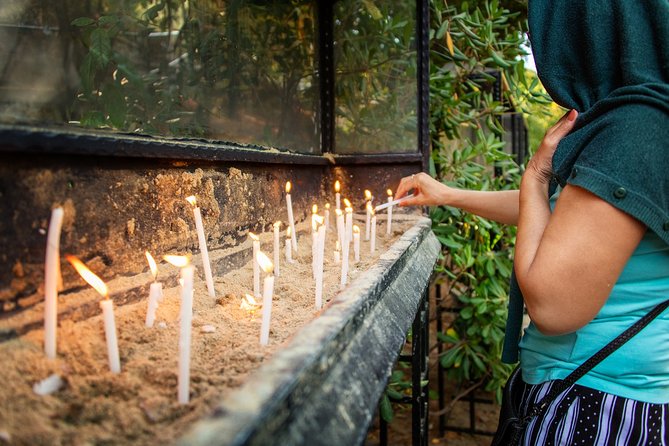
You get about 45 minutes here, with admission included. The small house itself is a shrine rather than a grand monument. You can go inside, see the sacred space, and visit the spring, which is associated with healing qualities.
This stop has a different mood from Ephesus. It is quiet, devotional, and important to pilgrims, while the later ruins are much larger and more archaeological. You do not need to be religious to appreciate the setting, but you should treat the site respectfully and follow any instructions about movement inside the shrine.
The mountain location also adds a change of scenery early in the day. The visit is not long, so it should not take away from the main archaeological stop.
Walking the ancient city of Ephesus
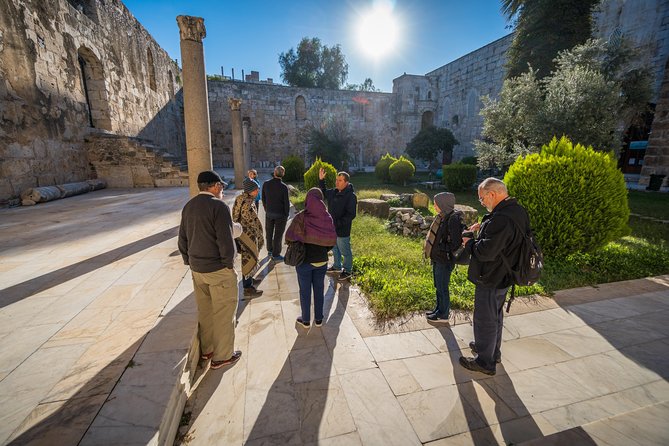
Ephesus is the reason to book this outing. The city was once the Roman capital of Asia Minor and reached its height during the first and second centuries AD. It was also a major trading centre and an important place for the worship of Cybele, the Anatolian fertility goddess.
You spend about two hours in the ancient city, with admission included. That is enough time to see the main monuments with a guide, though it is not enough to inspect every corner at a leisurely pace.
Your route can include the Odeon, an intimate semicircular building from the second century AD. It hosted political meetings, concerts, social events, and theatrical performances. Compared with the Great Theatre, its smaller scale helps you picture the city’s civic life in a more personal setting.
The Agora gives you a sense of Ephesus as a working city rather than a collection of impressive facades. The marble-paved Arcadian Way once provided a grand approach through the city. As you walk, your guide can connect the streets and buildings to daily life, trade, public gatherings, and Roman administration.
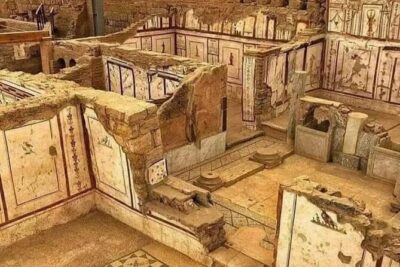
The Public Latrines and Roman Baths are especially useful stops for understanding ordinary city routines. They also remind you that ancient cities were planned around public facilities, not only temples and monuments.
Same coastline, a completely different sort of day:
- PRIVATE NO HIDDEN FEES Ephesus, Mary’s House Guided Tour /GRP OPT
★ 5.0 · 2,455 reviews - For Ship Guests:BEST SELLER EPHESUS PRIVATE TOUR & On Time Return
★ 5.0 · 2,029 reviews - ALL INCLUDED: Ephesus Ruins, Mary’s House Tour incl ENTRY TICKETS
★ 5.0 · 1,670 reviews - Ephesus Temple of Artemis and House of Mary Private Half Day Tour
★ 5.0 · 1,573 reviews
The Great Theatre and the Celsus Library
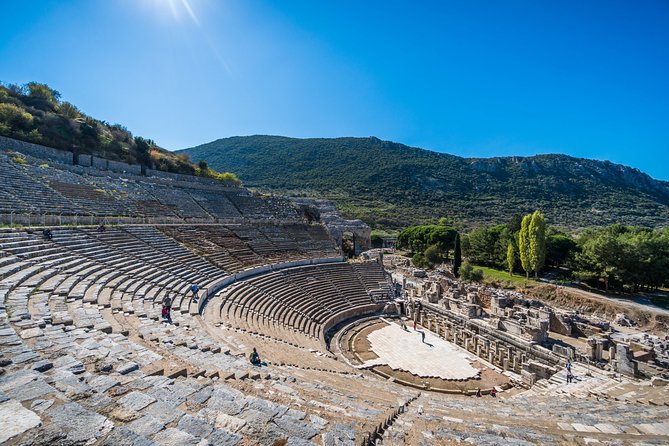
The Great Theatre is one of Ephesus’s most dramatic sights. Its marble seating once held as many as 24,000 spectators, making it easy to understand why this was more than an entertainment venue. It was a place for performances, public events, and large civic gatherings.
You have about 20 minutes specifically at the theatre, though the wider walk may give you additional views. Take a moment to look across the seating and imagine the scale of a crowd filling the slopes. The theater began in the Hellenistic period and was later expanded, adding another layer to its story.
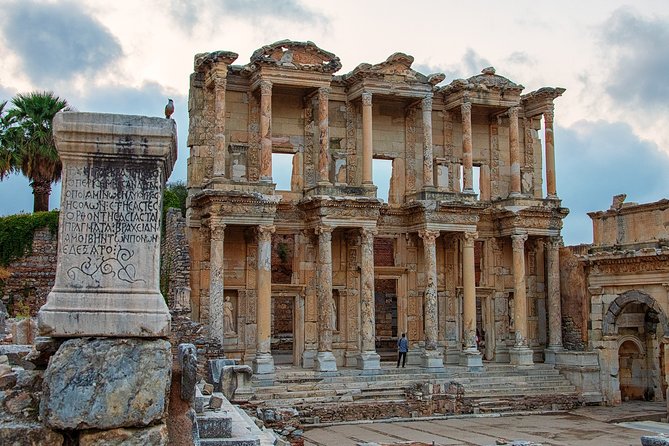
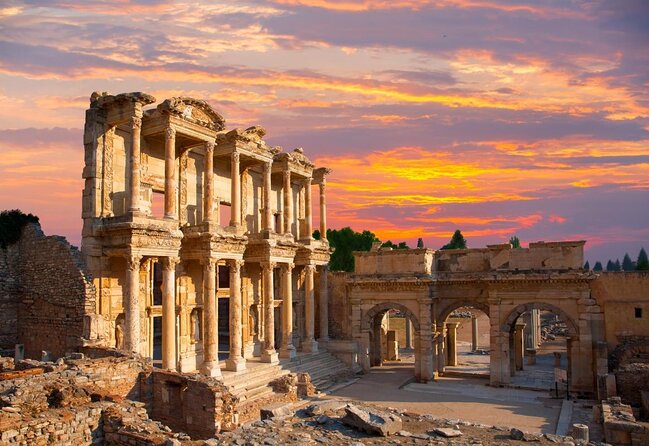
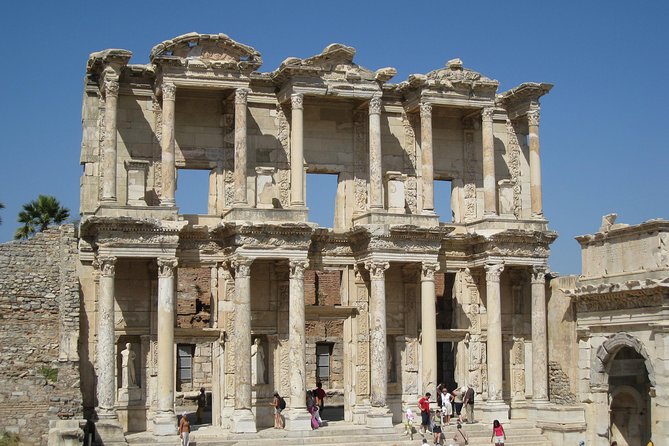
The Celsus Library is the most recognizable structure in Ephesus. Built in the early second century AD, its restored facade is carefully designed to look larger and taller than it really is. The curved base and the arrangement of the columns draw your eye toward the centre.
The niches contain replica statues representing Wisdom, Goodness, Thought, and Knowledge. The original building was part of a larger complex, so try not to judge it only as a beautiful facade. Your guide’s explanation helps you understand how the library fit into the city and why the building remains such a powerful symbol of Ephesus.
You get about 20 minutes here. That is enough for photographs and a short explanation, but the area can become crowded, so patience helps.
Temple of Hadrian and the smaller details
The Temple of Hadrian sits along Curetes Street and is regarded as one of the best-preserved structures in Ephesus. It was built in the early second century AD to mark Emperor Hadrian’s visit from Athens.
The building is smaller than the Great Theatre or Celsus Library, but its decorative details reward a close look. Your guide can help you read the structure as part of the street rather than as an isolated monument.
This is one of the places where a guide adds real value. The famous buildings are easy to spot. The smaller temples, civic spaces, and street features need explanation if you want to understand how the city functioned.
Expect about 15 minutes at this stop. The overall walking route is on ancient surfaces, so comfortable shoes are a practical choice. The tour information does not give a precise distance, but you should be ready for sustained walking through the ruins.
Isabey Mosque in Selcuk
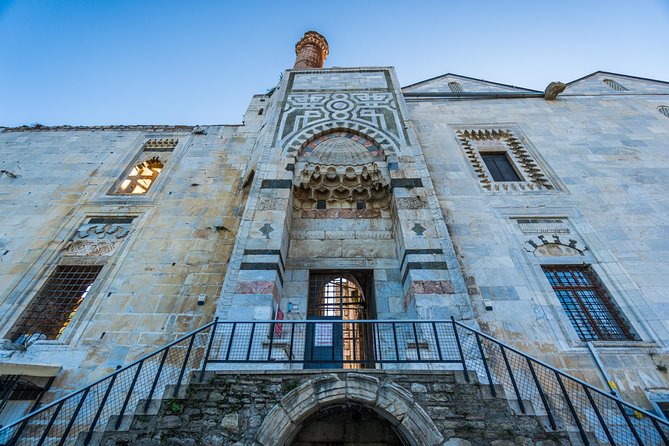
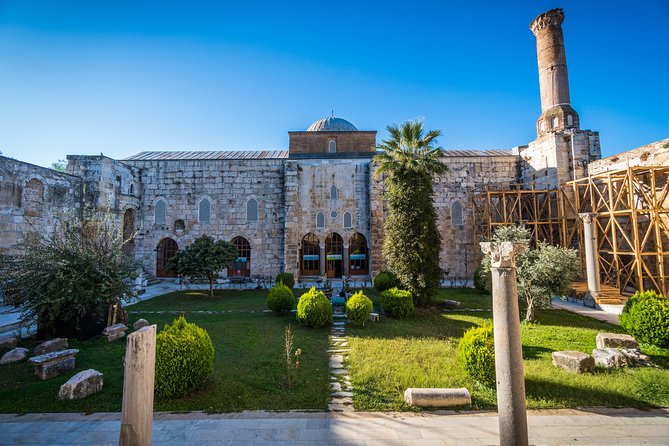
After the Roman sites, the tour moves to Selcuk for the Isabey Mosque. Built in 1375, it belongs to the period between Seljuk rule and the rise of the Ottoman Empire, when Selcuk was the capital of the Aydin Emirate.
The mosque gives the day a useful change of focus. Ephesus is associated with the ancient Mediterranean world, while Isabey reflects Islamic architecture from a much later period. The Arabic inscription above the entrance records its construction.
You spend about 20 minutes here. That is a short visit, but enough to admire the building’s transitional style and hear how Seljuk architecture fits into the region’s later story. Dress and behave respectfully at the mosque, following any instructions given by your guide.
What remains of the Temple of Artemis
The final historical stop is the Temple of Artemis, once one of the Seven Wonders of the Ancient World. At its height, the temple had 127 columns.
Today, very little remains. A single reconstructed column rises from an open field, which can feel anticlimactic after the scale of Ephesus. Yet that contrast is the point. You are looking at the remains of a monument once famous across the ancient world, not at a preserved building.
The stop usually lasts about 20 minutes. Keep your expectations realistic. This is a brief historical pause and a chance to understand the temple’s importance, not a second archaeological city.
Lunch, transport, and possible shopping stops
Lunch is included and is served as a buffet at a local restaurant. One account describes an outdoor meal on a lawn, and the food was a strong part of that day. The exact menu and setting can vary, but you can expect Turkish cuisine rather than a quick snack from a roadside counter.
Drinks are not included. Bring money for them, and remember that the tour price already covers the meal and entrance fees.
The air-conditioned vehicle is welcome after walking through the ruins, particularly during a warm day. Pickup is generally between 8:00 and 9:00 a.m. from Kusadasi, or between 9:00 and 9:30 a.m. from Selcuk. The final time depends on your pickup point and the other people being collected, so contact the operator the day before.
There is one important point to clarify before booking. Some departures have included visits to a carpet showhouse, leather showroom, jewelry maker, or pottery shop. These stops have been described as arts and crafts visits, but they can involve strong sales pressure and expensive products.
They are not listed among the eight main sightseeing stops described for the tour, so ask the operator directly if they are planned for your date. If you want an archaeology-first day with no shopping, this question matters.
Who will get the most from this tour?
I would choose this tour if you want the practical side of sightseeing handled for you. Pickup, transport, tickets, lunch, and a guide are bundled together, and the small group gives you a better chance of hearing the explanations.
It suits first-time visitors to Ephesus, cruise passengers with limited time, families, and anyone who wants to combine several nearby sites in one day. The range is particularly useful if your interests go beyond Roman ruins.
It may not suit you if you want a slow, independent visit. Two hours in Ephesus is useful but structured, and the day has several short stops. It may also disappoint if you expect the House of Virgin Mary or Artemis Temple to be large monuments rather than brief, meaningful visits.
Should you book it?
Book this Ephesus tour if you value a well-organized day, an English-speaking guide, included admission, and a group no larger than 15. The strongest parts are the time in Ephesus, the excellent Celsus Library and Great Theatre, the good lunch, and the simple hotel or port transfers.
Before paying, confirm the pickup time and ask whether shopping stops are included. If the answer is clear and the route matches your interests, the $174.60 price can be fair for a seven-hour outing with transport, lunch, tickets, and guiding. Cancel at least 24 hours before the start time if your plans change, since later cancellations are not refundable.
FAQ
How long does the Ephesus tour last?
The tour lasts approximately seven hours, including pickup, transport, sightseeing, lunch, and the return to Kusadasi.
What time does pickup take place?
The stated start time is 8:30 a.m. Kusadasi pickups usually take place between 8:00 and 9:00 a.m. Selcuk pickups usually take place between 9:00 and 9:30 a.m. Your final pickup time is confirmed the day before.
Is lunch included?
Yes. A buffet lunch is included. Drinks are not included and must be paid for separately.
How many people can join the tour?
The tour has a maximum of 15 participants. On some dates, the group may be smaller.
Are entrance fees included?
Yes. Entrance fees and taxes are included for the listed sightseeing stops, including Ephesus and the House of Virgin Mary.
Can I cancel for a full refund?
Yes, if you cancel at least 24 hours before the experience start time. Cancellations or changes made less than 24 hours in advance are not accepted for a refund.
Just added around Kusadasi
- Quick-Ephesus Private Tour★ 5.0 · 10 reviews
- ONLY FOR CRUISE GUESTS / Top Seller Ephesus Tour★ 5.0 · 9 reviews
- Private Pamukkale and Ephesus Tours★ 4.5 · 3 reviews
- For Cruisers : Private Ephesus Tour With Local Tour Guide★ 5.0 · 8 reviews
- Private Tour : Ephesus Port Tour for Cruisers★ 5.0 · 4 reviews
- Private Tour of Ephesus,House of Mother Mary &Artemis Temple from Izmir★ 5.0 · 4 reviews
- For Cruise Guests : Best of Ephesus Private Tour / Kusadasi Tours★ 5.0 · 6 reviews
- FOR CRUISE GUESTS : Ephesus Private Tour / ON TIME RETURN TO SHIP★ 5.0 · 13 reviews
Ephesus Tours from Kusadasi, compared.
FOR CRUISERS: Skip The Lines PRIVATE EPHESUS TOUR &On Time Return
Read our review →
Top Choice For Cruisers: Ephesus, Mary’s House WITH TICKETS+LUNCH
Read our review →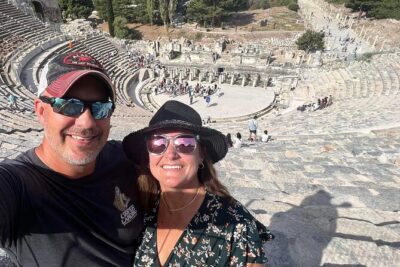
PRIVATE EPHESUS TOUR FOR CRUISERS: On-time Return and Skip-Line
Read our review →
For Ship Guests:BEST SELLER EPHESUS PRIVATE TOUR & On Time Return
Read our review →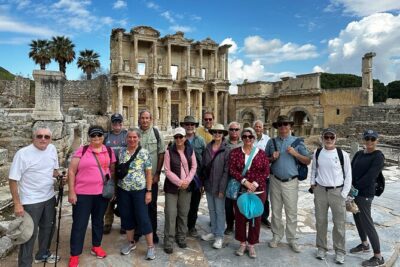
ALL INCLUDED: Ephesus Ruins, Mary’s House Tour incl ENTRY TICKETS
Read our review →
Ephesus Temple of Artemis and House of Mary Private Half Day Tour
Read our review →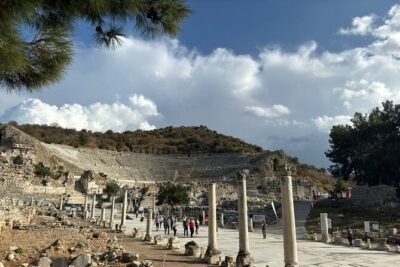
PRIVATE TOUR FOR CRUISERS: Mary’s House (Meryemana) and Ephesus
Read our review →